Post-OBBB math: fleet electrification gets harder, but many EVs will continue to be economic - if you know where to look
🚨 The Federal EV tax credit is ending after September 30
This includes the $7,500 credit for new light-duty personal and commercial vehicles, along with the up to $40,000 credit for heavy-duty commercial EVs. Clearly, this makes each EV more expensive than it was before, but is it enough to change fleet decision-making?
How the tax credit affects EV economics: a real-world example.
We used Rappel’s CO2-AIM model to evaluate our database of light-duty pickups, the linchpin of many commercial fleets. The federal EV tax credit is worth an average of ~10% of the total lifetime cost of ownership (TCO) of a light-duty EV pickup truck in 2026, assuming a 5 year / 100K mile lifetime.
Before the OBBB’s passage, EVs were more economical than conventional trucks for about 70% of the trucks in our database that are up for replacement in 2026. After the OBBB, that number has dropped to about 32%. But that means that EVs are still the economic choice for about 1/3 of the light-duty pickup trucks that we track. Why?
Location and use profile can swing economics by $20K or more, far more than the EV tax credit.
Take two fleets of F-150s—one operating in Nevada, the other in Virginia. Each fleet includes vehicles driving approximately 10-30K miles per year. Using CO2-AIM, we compared the cost of new EVs to their conventional alternatives, excluding the federal EV credit (see chart below).
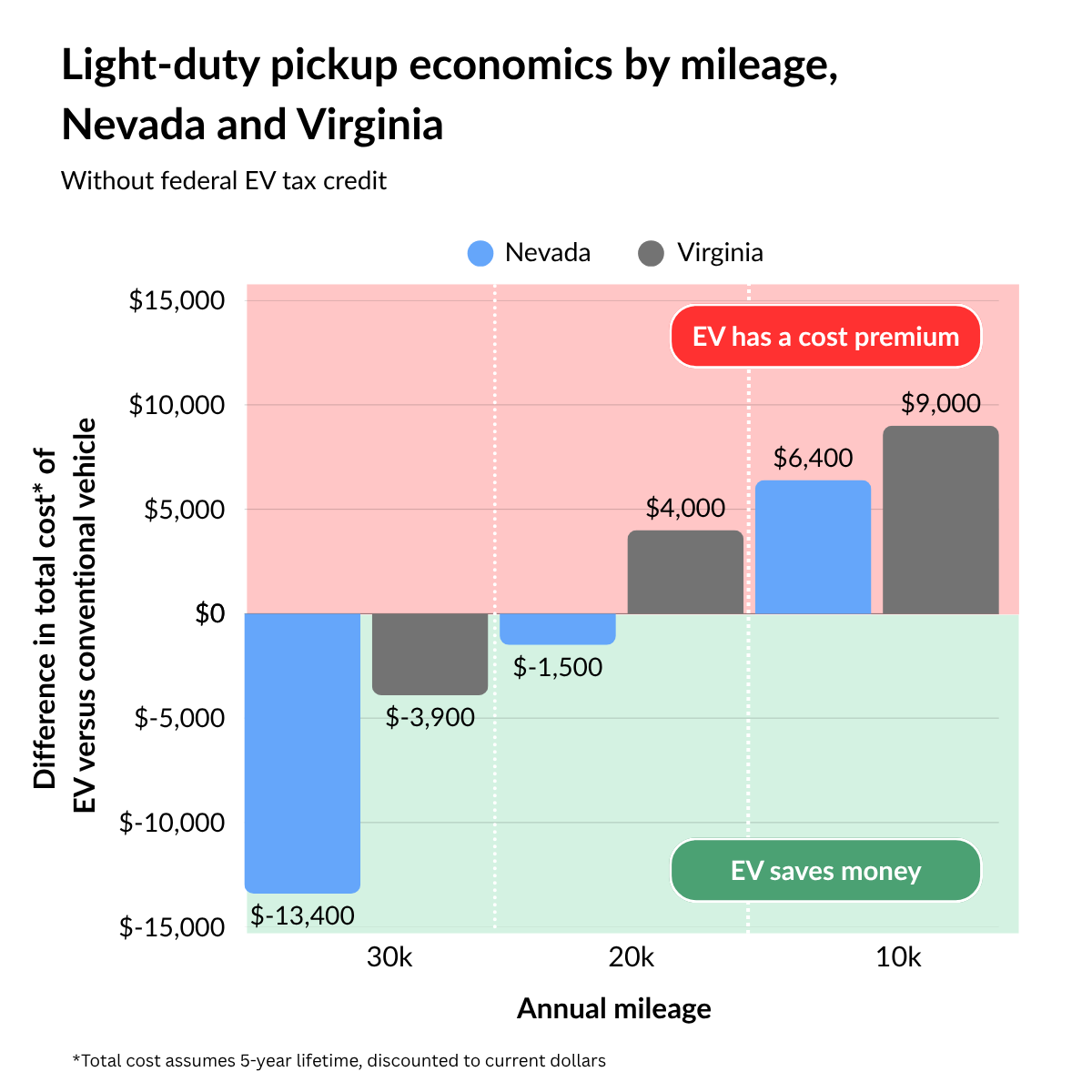
EV economics are just as sensitive to local factors (gasoline is about $1/gallon less in Virginia than Nevada, while registration and insurance tends to be higher in Nevada ) and to usage characteristics (high mileage and duty cycles advantage EVs), as they were to the federal tax credit. Depending on where and how a vehicle operates, electrification may or may not pencil out.
👉 Takeaway: EV economics are about 10% worse without the federal tax credit, but fleet managers still have many economic opportunities for EV adoption.
Asset-level dynamics (location, usage) are even more important drivers of EV economics with the tax credit eliminated, so fleet managers will need a more tailored approach to maximize their economics. Beyond EVs, there are many additional economic options for decarbonizing many vehicles your fleet, including hybrids, downsizing, idle reduction technologies, and route optimization – none of which were affected by the OBBB.
🔧 Need help navigating the post-OBBB world?
We work with financially motivated companies to navigate decarbonization and operational excellence opportunities with specificity and affordability in mind.