Climate risk: transforming a regulatory requirement into a strategic resource

Climate risk: transforming a regulatory requirement into a strategic resource
The deadline for Senate Bill (SB) 261, California’s Climate-Related Financial Risk Act, is January 1, 2026. Are you prepared?
SB 261 requires companies with greater than $500M in revenues that are doing business in California to disclose their assessment of organizational climate risks. Even if SB 261 doesn’t apply to your company directly, climate risk disclosure is becoming increasingly prevalent, as standards like the Carbon Disclosure Project (CDP) include risk assessments in their frameworks.
In this post, we’ll explore how you can turn the regulatory burden into real business value – using the work you’re already doing for compliance to strengthen strategy, resilience, and competitiveness.
👉 To get a detailed breakdown of what California’s SB 261 (and SB 253) require and who is in scope, check out the California Air Resources Board (CARB)’s workshops and resources page.
Risk management as strategy
Where many firms stop at disclosure, Rappel sees opportunity. Through our decarbonization work, we’ve seen that going beyond compliance can improve operations, lowers costs, and build competitive advantage. The same is true for climate risk.
While climate risk disclosure may feel like a burden to those who are new to it, it’s also a chance to build a strategy for long-term resilience, smarter-decision making, and long-term success – when approached with the right objectives:
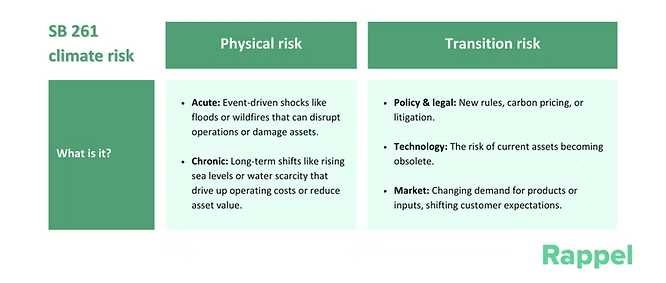
1. Physical risk: sharpening operational decisions
Facility-level exposure mapping for hazards like floods, wildfires, or heatwaves helps companies see where they’re most vulnerable and prioritize investments accordingly.
Supply chain/logistics leader Prologis, for example, uses asset-level hazard data to embed location-based risk assessments into capital planning and asset management. They’ve used their physical risk assessment to focus near-term spend on resilience-building (i.e. insulation upgrades, hail guards) for assets in high-risk geographies in order to protect business continuity and reduce exposure.
Rappel’s approach: We map assets against hazard exposure models, for both current and future climate scenarios, to highlight vulnerabilities across critical facilities.
2. Transition risk: future-proofing governance and competitiveness
Regulations such as SB 261 in California and the EU’s Carbon Border Adjustment Mechanism (CBAM) are increasing the financial risks of non-compliance. Shifts to new lower carbon technologies, from electric vehicle (EV) adoption to renewable power, are stranding outdated fossil assets. Customers like Amazon and AstraZeneca now require their suppliers to set science-based carbon reduction targets, putting unprepared companies at risk of losing revenue and market share. Transition risk analysis helps leadership teams confront these shifts head-on and align governance, investment, and product positioning with future realities.
For transition risk, Prologis is piloting an internal carbon price to inform investment decisions around reducing risk exposure and enhancing long-term asset value and revenue growth.
Rappel’s approach: We run focused transition risk workshops with leadership teams to explore future climate policy, technology, and market scenarios, and to identify strategy implications.
3. Integrate climate risk with decarbonization: one effort, double the value
Climate risk analysis and decarbonization planning often run in silos, even though they rely on the same inputs and impact one another directly. Bringing them together creates a more coherent story and avoids duplicate effort. The same facility and operations data that power climate risk disclosure can also feed a GHG inventory, reveal emissions hotspots, and point to efficiency levers that drive cost savings.
Rappel’s approach: Using our CO₂-AIM platform, we apply asset-level data to both climate risk assessment and decarbonization roadmaps, identifying operational opportunities and modeling cost-saving reduction actions in one process.
Where to start if you’re preparing for SB 261
California regulators haven’t released the final requirement for SB 261 reporting (expected December 11 - 12, 2025), but here are a few simple tips based on CARB’s draft guidance and the Task Force on Climate-related Financial Disclosures (TCFD) framework:
- Start with what you already have. Even though you may not have thought about climate risk before, you may already capture climate-relevant insights without calling them that. A few good places to start:
- Business continuity plans → Scenario planning for downtime and resilience (e.g., ability to shift to remote work) can help identify transition risks.
- Real estate strategy → Purchase/lease decisions often weigh physical risks (flood, seismic, extreme heat exposure).
- Insurance policies → Coverage requirements (flood, earthquake, wildfire) recognizes physical risk hotspots.
- Operational shifts → Adjusting activities during wildfire or hurricane season provide built-in physical risk awareness.
- 10-K reports → Disclosures on climate risks, metrics, and financial impacts sets the baseline for financial risk analysis around climate change.
Taken together, these give you a head start on identifying where climate risks already intersect with business risks.
- Don’t overcomplicate your first risk report. 2026 filings can lean on qualitative analysis and “best effort.” Use the first report as an opportunity to learn and identify future improvements.
- Bring the right people in. Finance, operations, legal, and procurement should be at the table alongside sustainability leaders. Otherwise, climate risk reporting can feel disconnected from the realities of the business.
- Experiment with scenarios. Even a basic “what if” analysis — comparing a 1.5°C transition pathway against a high-warming future — can surface useful insights for strategy.
Closing thought
Climate risk reporting is coming fast. You can treat it as another compliance task, or you can use it as an opportunity to build resilience and uncover savings.
We’ve seen that when companies go beyond disclosure, they make better decisions, strengthen customer trust, and find real competitive edge.
🔧 Need help navigating how to best respond to SB 261?
We work with financially motivated companies to navigate climate risk and decarbonization opportunities with specificity and affordability in mind.